How it works
One set of effect modules, used three ways. Written in C++ with JUCE, tested by measuring the sound.
Modules, not plugins
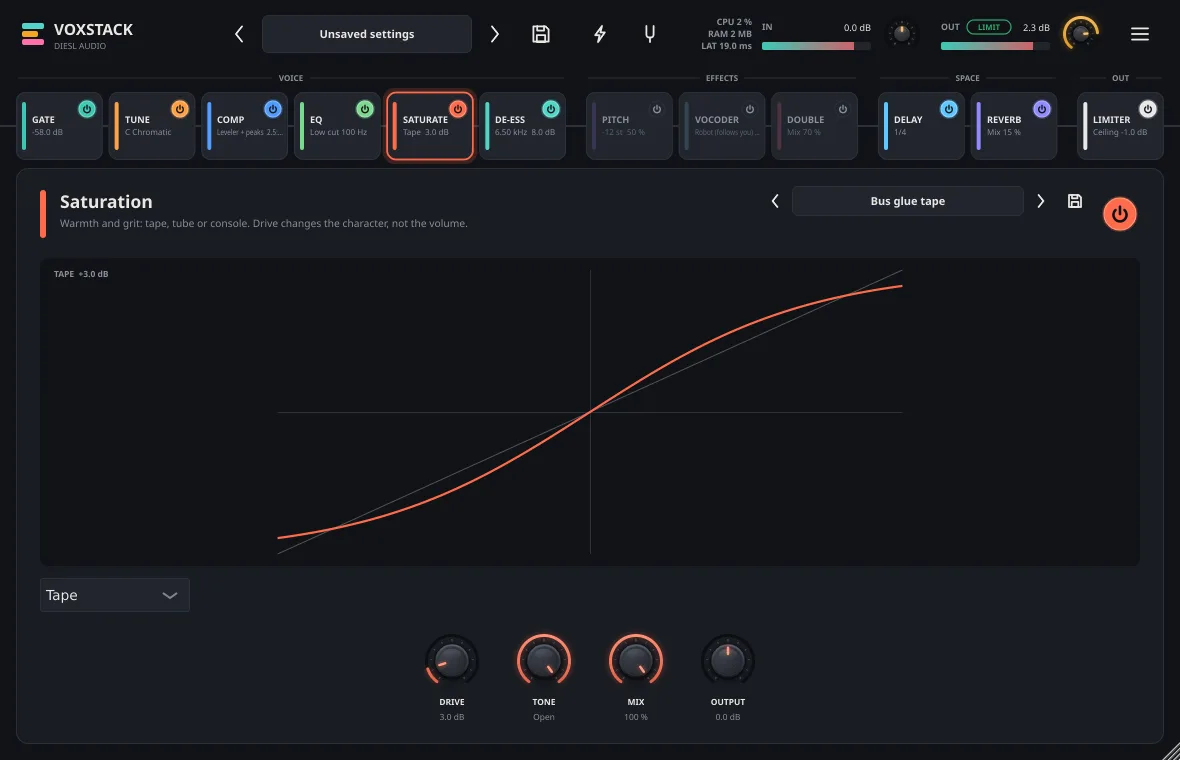
Every effect – gate, compressor, EQ, reverb, autotune – is a module: its parameters, its DSP and its page in one place. The same module is a block in AmpStack, a block in VoxStack and a Diesl plugin of its own. Fix the compressor once and it is fixed everywhere; a preset saved in AmpStack's EQ shows up in Diesl EQ.
Real amps, not simulations
AmpStack does not model circuits. It plays Neural Amp Modeler captures – a neural network trained on a real amp – followed by a cabinet impulse response. The free sound kit (Vox AC30, Marshall JCM800, Orange, EVH 5150, three cabinets) comes from TONE3000, and the presets are built and level-matched on it.
Presets you can trust
- Every whole-chain preset is levelled to the same loudness, so switching does not fool your ears.
- Every block has its own presets, grouped by what they are for (guitar, vocals, bus, drums…).
- A chain preset is also a preset of each block it uses, so you can borrow just its EQ.
- Change something and the preset name gets a star; switching asks what to do with your edits.
Measured, not guessed
More than a hundred automated tests. They do not check that the code runs, they check the sound: a dynamic EQ band takes exactly 9 dB off a loud note and nothing off a quiet one; the master limiter lets nothing over the ceiling; a ducked reverb is 12 dB down while you sing and back within 300 ms. Nothing reaches my Reaper before the tests pass. That is also the main way AI-written code gets kept honest.
Built for playing
Latency is shown per block, and the low-latency bolt switches every block that can to a faster mode (autotune from 18 to 3 ms). AmpStack and VoxStack also run as standalone apps, without a DAW.